
Med spa accounting is the full financial operating system for an aesthetics practice: bookkeeping built for product and service revenue, monthly reporting you can actually make decisions from, proactive tax strategy, and the accounting discipline an MSO structure requires. It works differently than accounting for a typical small business, because a med spa carries inventory, sells packages paid upfront, compensates providers in ways that carry tax consequences, and often runs two legal entities. Get these pieces working together and your numbers become a tool. Leave them disconnected and they become a source of surprises.
At Liguori Accounting, we work exclusively with medical aesthetic practices, so this guide is the overview we wish every owner had before they hired a generalist who was learning their industry on their dime. Below is how the whole picture fits together, with links to the deeper breakdowns on each piece.
What makes med spa accounting different from regular business accounting?
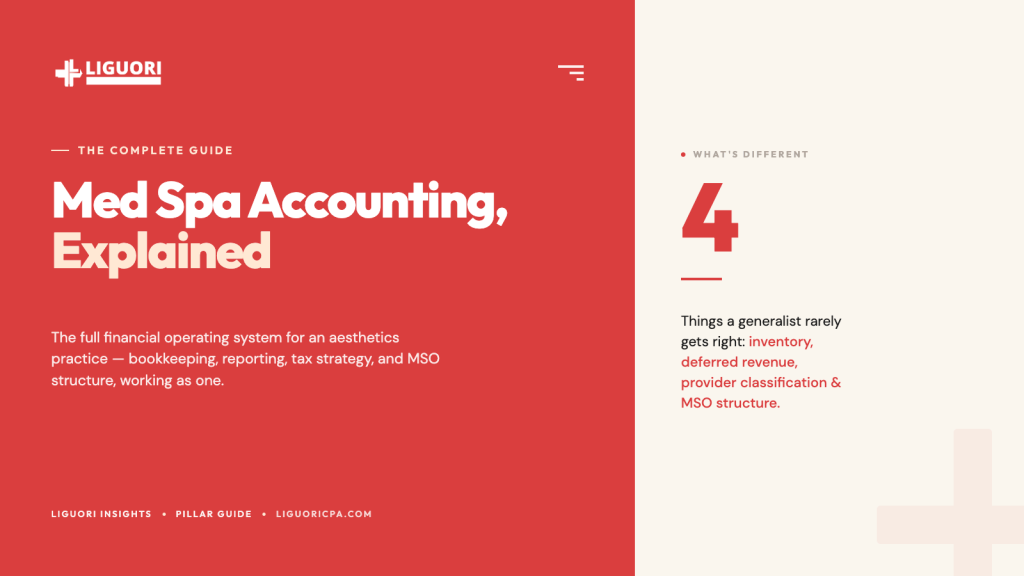
Four things that a generalist rarely handles correctly: inventory, deferred revenue, provider classification, and MSO structure.
A med spa buys product it holds before using, which means inventory has to be tracked as an asset and expensed only as it is consumed. It sells packages, memberships, and gift cards that are paid today and delivered over months, which creates deferred revenue that is a liability, not income, until earned. It pays injectors and aestheticians in ways that raise real worker classification questions. And many practices operate under a management services organization, with a clinical entity and a management entity that each need their own clean books. None of these are edge cases in aesthetics. They are the core of the business, and they are exactly what standard small business accounting was not built for.
What does good med spa bookkeeping look like?
It starts with a chart of accounts that mirrors your service lines, so you can see product and service margins separately, and a monthly close that keeps inventory and deferred revenue accurate.
If your revenue is lumped into one income account and your product cost is buried in a pile of expenses, your reports cannot tell you which parts of the practice make money. The fix is structure: revenue broken out by category, cost of goods sold mapped to those categories, inventory on the balance sheet, and deferred revenue recorded as the liability it is. We walk through exactly how to set this up in our guide to med spa bookkeeping and how to structure your chart of accounts. That foundation is what everything else in this guide depends on.
How do I actually understand my med spa’s numbers?
Read your profit and loss statement and your balance sheet together every month, watch cash separately from profit, and break profitability down by segment instead of looking only at the total.
Three ideas do most of the work here. First, profit and cash are not the same thing, and the gap between them is where profitable practices get caught short, usually because cash is tied up in inventory or owed on packages already sold. We cover this in why your P&L isn’t telling you the whole story. Second, a single profit number hides which providers and which treatments actually carry the practice, which is why we recommend measuring profitability by provider, treatment, payroll, and product margin. Third, a handful of metrics tell you where things are heading before the P&L does, which we lay out in the KPIs every med spa owner should track. The related trap of a packed schedule that does not produce profit is worth understanding too, and we broke that down in why some med spas make millions in revenue but have no profit.
How should a med spa approach taxes?
Proactively and year-round, not once in the spring. The difference between compliance and strategy in this industry is measured in tens of thousands of dollars.
Compliance is filing an accurate return after the year is over. Strategy is looking at your entity structure, your compensation, your equipment timing, and your retirement plan throughout the year, while you can still change the outcome. For med spa owners, the highest-leverage moves usually involve entity structure, the salary-to-distribution split on an S-corp, equipment depreciation timing, and the specific tax advantages an MSO structure can create. We detail the strategy side in tax strategies that can reduce your med spa’s taxable income, and you can see our tax services for how we structure that support. The core mistake we see is waiting until the return is due, when almost nothing can be changed.
What does an MSO structure require from an accounting standpoint?
Clean separation between the two entities, revenue and expenses flowing to the right places, and a management fee that holds up under scrutiny.
Having the legal documents drafted is only half of it. The funds have to actually flow the way the structure intends, which means separate bank accounts, patient revenue landing in the clinical entity, expenses hitting the right books, and a management fee that transfers profit to the management company without looking like fee-splitting to a medical board. We cover the operational side in MSO funds flow for med spas and the fee itself in how to structure your med spa MSO management fee. Provider classification sits alongside this, because getting 1099 versus W-2 classification wrong can be an expensive problem to unwind.
How does accounting support the big decisions, like hiring, equipment, and selling?
By turning your numbers into the basis for decisions instead of guesses. This is the CFO layer that sits on top of clean books and good reporting.
When your financials are accurate and current, you can answer the questions that actually move the business. When can you afford to hire, and at what utilization. Whether an equipment purchase pays for itself or just adds a fixed payment. Whether the practice is built to sell, which is a multi-year project, not a last-minute one, as we cover in how to prepare your med spa for a sale. This is what our Virtual CFO services are built to provide: the analysis behind the decisions, not just the reporting behind the tax return.
When should a med spa outsource its accounting?
When the cost of inaccurate or missing financial insight starts to exceed the cost of professional help, which usually arrives sooner than owners expect.
Doing your own books early on is reasonable. But once you are carrying inventory, running an MSO, selling packages, and making real decisions about staff and equipment, the stakes change. Bringing bookkeeping, tax, and CFO support under one roof means the same team that keeps your books also plans your taxes and helps you read your numbers, which is where the compounding value comes from. You can see how our outsourced accounting tiers are structured to scale with a practice.
Frequently Asked Questions
Do I need a med spa specialist, or will any CPA do?
You need someone who understands aesthetics. Inventory, deferred revenue, provider classification, and MSO structure are the core of med spa accounting, and a generalist who has not handled them will usually learn on your dime and often get them wrong. A specialist already knows what to ask and what to watch.
How much does med spa accounting cost?
It depends on the size and complexity of the practice and how much support you need, from bookkeeping only up to full CFO and tax planning. The more useful way to think about it is against the cost of not having it: missed tax strategy, decisions made on bad numbers, and cash surprises usually cost far more than the service.
Can you help if my books are a mess or behind?
Yes. Cleaning up disorganized or backlogged books is one of the most common things we do when a new med spa comes on board. We rebuild the chart of accounts, correct the inventory and deferred revenue, and get you to reports you can trust before we plan anything else.
I already have a bookkeeper. Do I still need this?
Possibly, depending on what your bookkeeper covers. Many med spas have someone recording transactions but no one setting up the books for aesthetics, planning taxes proactively, or helping them read the numbers. The gap is usually strategy and industry-specific structure, not basic data entry.
If you want the full picture working together, books built for a med spa, proactive tax strategy, and someone helping you read the numbers, that is exactly what we do. Start a conversation with our team and we will show you where your practice stands.