
Here is something that surprises most med spa owners when we first sit down together: taxes are typically the largest expense in their business after cost of goods and payroll. Not rent. Not marketing. Not payroll taxes. Federal and state income tax.
And yet for most practices, it is also the least strategically managed expense in the building.
That is not a criticism. It is a structural problem with how accounting is typically sold and delivered to small business owners. You get a CPA who files your return in March. You find out what you owe in April. And by then, there is almost nothing you can do about it.
Proactive tax strategy works completely differently. It starts in January, not March. It looks at your business structure, your compensation, your assets, your retirement plan, and your timing. And it stacks legal strategies on top of each other to produce results that a single deduction never could.
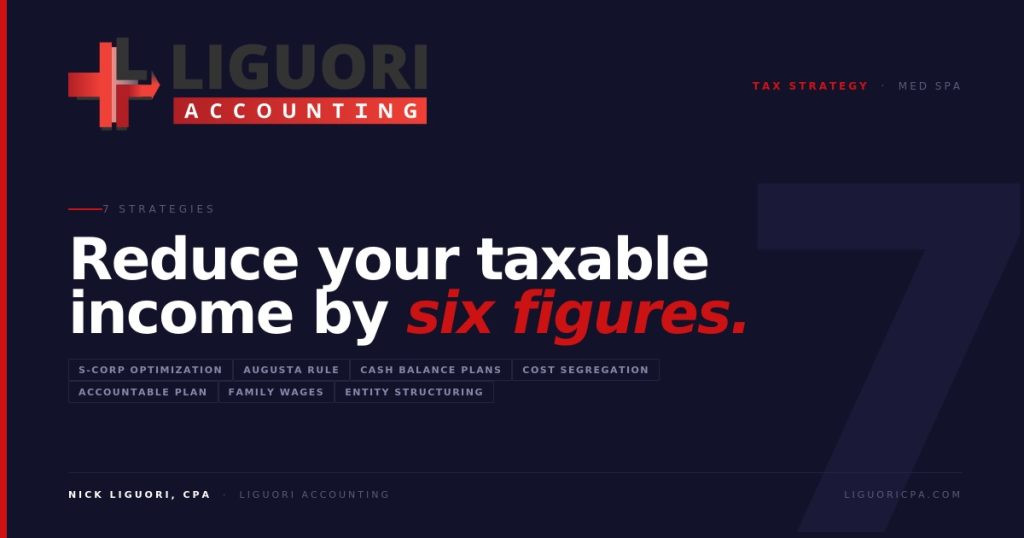
This post covers seven tax strategies that are specifically well-suited to med spa owners. Used in combination, they can reduce taxable income by $100,000 to $200,000 or more annually. None of them are aggressive or outside the law. They are simply strategies that require planning to implement correctly.
Why Med Spas Are Particularly Vulnerable to Overpaying
Before getting into the strategies, it helps to understand why this problem is so common in medical aesthetics specifically.
Med spas tend to have strong profit margins. They grow quickly. They are usually owner-operated, which means the business owner is often taking most of the profit as personal income. And because the business model is relatively straightforward on the surface, many owners assume their tax situation is not complicated enough to warrant a sophisticated strategy.
That assumption is expensive.
When most of the profit runs through the owner as a W-2 salary, every dollar gets hit with payroll taxes, federal income tax, and state income tax with little or nothing structured to reduce that load. Add in the fact that most med spas are not taking full advantage of depreciation, retirement vehicles, or entity structure, and you have the conditions for a significant and unnecessary tax bill.
The good news is that this is fixable.
Strategy 1: S-Corp Compensation Optimization
If your med spa is structured as an S-Corporation, how you split compensation between salary and distributions matters enormously.
All wages paid through an S-Corp are subject to payroll taxes, which includes both the employer and employee portions of Social Security and Medicare. Distributions, by contrast, are not subject to payroll taxes. The IRS requires that owner-operators pay themselves a “reasonable salary” for the work they perform, but compensation beyond that threshold can be taken as a distribution and pass through without payroll tax.
The mistake we see repeatedly is owners taking their entire profit as salary because no one has ever structured it differently. On $500,000 in business profit, optimizing the salary-to-distribution split can produce tens of thousands of dollars in annual payroll tax savings.
This is not about paying yourself less. It is about paying yourself in the most tax-efficient way possible.
Strategy 2: The Augusta Rule
Section 280A of the tax code allows a homeowner to rent their personal residence to their business for up to 14 days per year without that rental income being taxable. The rental expense is still deductible to the business.
This is often called the Augusta Rule because it became widely known through its application to homeowners near Augusta National Golf Club renting their homes during the Masters tournament.
For a med spa owner, this means you can rent your home to your business for team meetings, planning sessions, training days, or similar business activities, charge a market rate for the space, deduct the expense in the business, and receive the rental income personally without it appearing on your tax return as taxable income.
The key requirements are that the rental must be for a legitimate business purpose, the rate must be consistent with what a comparable venue would charge, and you must document it properly.
Strategy 3: Advanced Retirement Planning
Most business owners are familiar with a 401(k) or a Solo 401(k). But these vehicles have contribution limits that cap out well below what high-earning med spa owners could potentially be sheltering from taxes each year.
Cash balance plans are a defined benefit retirement vehicle that allows significantly higher annual contributions. Depending on age and income, a cash balance plan can enable deductions of $100,000 to $300,000 or more annually. Those contributions reduce taxable income dollar for dollar in the year they are made.
This strategy is particularly powerful for med spa owners in their 40s and 50s who have strong, consistent income and want to aggressively build tax-advantaged retirement assets while reducing their current-year tax liability.
The plan requires actuarial administration and must be set up before the end of the tax year to apply for that year, which is one more reason why proactive planning is essential.
Strategy 4: Cost Segregation and Accelerated Depreciation
When you build out a med spa space, renovate a treatment area, or invest in equipment, those costs are typically capitalized and depreciated over many years. A standard commercial buildout might be depreciated over 39 years.
Cost segregation is an engineering-based study that identifies components of that buildout that qualify for shorter depreciation periods, often 5 to 15 years. Combined with bonus depreciation provisions that allow a percentage of qualifying assets to be expensed immediately, this strategy can produce large front-loaded deductions in the year you make the investment.
For a med spa that has recently completed a buildout, expanded to a new location, or purchased significant equipment, a cost segregation study can generate deductions in the range of tens of thousands to hundreds of thousands of dollars in year one rather than spreading them across decades.
Strategy 5: The Accountable Plan
An accountable plan is a formal business arrangement that allows you to reimburse yourself for legitimate business expenses that you pay personally, without that reimbursement being treated as taxable income to you or subject to payroll taxes.
Many business owners pay for expenses like home office costs, phone and internet, mileage, and continuing education out of pocket and never deduct them properly. An accountable plan creates the documentation structure to reimburse these expenses through the business, making them deductible to the business and tax-free to you personally.
The IRS requires that the expenses have a legitimate business purpose, that they are substantiated with receipts and records, and that any advances are returned within a reasonable time. When structured correctly, this is a clean and straightforward way to shift the tax treatment of expenses you are already incurring.
Strategy 6: Hiring Family Members
If your spouse or children perform legitimate work in the business, paying them a reasonable wage for that work can shift income from your higher tax bracket into their lower bracket.
For a spouse employed in the business, you gain a W-2 earner whose wages are deductible to the business. For children under 18 employed in a parent-owned sole proprietorship or partnership, wages are generally not subject to Social Security and Medicare taxes, and the child’s standard deduction may shield a significant portion of their income from tax entirely.
The work must be real, the compensation must be reasonable for the work performed, and everything must be properly documented. But for med spa owners with family members who contribute to administrative work, social media, cleaning, or other functions, this strategy can meaningfully reduce the family’s total tax burden.
Strategy 7: Timing and Entity Structuring
The last strategy is less a single tactic and more a category of planning decisions that involve when income is recognized, how entities are structured relative to each other, and how assets are owned.
For example, timing the purchase of equipment or the payment of certain expenses before year end can shift deductions into the current tax year. Separating real estate from the operating business into a distinct entity can create rental income structures that are taxed differently and provide asset protection benefits.
Entity structuring decisions, such as whether to hold your practice as an S-Corp, a C-Corp, or in combination with a holding entity, can have significant implications for how and when income is taxed. These are not one-time decisions. They need to be reviewed as the business grows and as tax law changes.
What Stacking These Strategies Actually Looks Like
No single strategy in this list produces a six-figure tax reduction on its own. The impact comes from coordination.
Consider a med spa owner with $500,000 in annual profit. S-Corp compensation optimization might produce $25,000 in payroll tax savings. A cash balance plan contribution could reduce taxable income by $100,000. A cost segregation study on a recent buildout might generate another $60,000 in deductions. The accountable plan might add $15,000 more.
That is $200,000 in taxable income reduction from strategies that are entirely legal, well-documented, and available to most profitable med spa owners today.
The reason most owners are not using them is not that they are complicated. It is that no one has put them together into a coordinated plan.
The Role of a Proactive Accounting Partner
Tax preparation is backward-looking. Tax strategy is forward-looking. The difference between an accountant who files your return and a team that actively plans your tax position throughout the year is the difference between discovering what you owe and actively reducing what you owe.
At Liguori Accounting, we work exclusively with medical aesthetics practices. We understand the MSO structure, the compliance landscape, and the specific tax opportunities available to med spa owners at different stages of growth. Our tax services are built around proactive planning, not just preparation.
If you want to understand what your current tax structure is costing you and what a strategic approach could change, we offer a complimentary discovery call. You can learn more about our services at liguoricpa.com and explore how our virtual CFO services can bring senior financial strategy to your practice on a fractional basis.
Taxes are your largest controllable expense. Treat them that way.